Showing posts with label Meet the Mentors. Show all posts

Wednesday, 27 April 2016

Meet the Mentor: Filipa Vance


School Science Club? Just do it.

I love Science. I really do!

I love the challenges it poses, the buzz of making sense of problems, the excitement of checking whether an experimental approach has worked, the never ending questions and, above all, the fact that we learn something every step of the way.

Having said that, it will come as no surprise that I like to talk about Science, too. I like to discuss thoughts and ideas; I like to hear other people’s views and thoughts on anything from Maths problems, to antibiotics usage. More recently, I have discovered the joy of talking about Science to primary school kids. I have learnt so much from their bright, young, unbiased minds and I have been challenged in a way that I never imagined possible.

In October of last year, I (finally) managed to set up a Science Club at my children’s school, St Louis RC Primary School in Frome. It was not an easy thing to do, I have to be honest. It took me almost 2 years to get a Science Club going and, in hindsight, I must admit I was the one who slowed it down. Had I been more confident in my ideas I could have set up this club long time ago.
It all started back in 2014 when I joined ScienceGrrl and, together with Becky Smith, formed the Oxford Chapter. Our ambition for this Chapter was clear – we wanted to act locally and share our passion for STEM with the next generation. The Chapter allowed me to meet fantastic ScienceGrrls with diverse science-based careers: from communicators to helicopter engineers. The group we formed was inspiring in more ways than one and planted the seed to go out to the community to talk about Science. We did the usual festivals and fairs but I never managed to develop the close relationship I had hoped for with any local schools. I was working full time at that point and about to move away from Oxfordshire, so things were a bit chaotic.

In late 2014 my husband was offered his dream job and so we moved to the South West. It quickly became apparent that moving kids away from friends, changing school, football team etc. was going to be challenging. So, to give the children the support they needed, I decided to take a career break of sorts. I found myself a part time job at the University of Bath and started to help out at their school with the usual tasks – reading, taking kids on walks and days out. The idea of a Science Club was still very much inside my head but I was not sure how to get it off the ground. I contacted the STEM Ambassadors, and enrolled to become one. The induction course was great and I really enjoyed it. All of their courses are free and the follow up sessions are always very informative.

I continued to help out with reading at the school and mentioned my newly awarded ‘STEM Ambassador’ status to anyone who would listen. Teachers are busy people and the road not taken is often a scary one. In fairness, I could have tried harder. It wasn’t until this academic year that my words fell on the right ears and together with Ms Hannah Jones, Science Coordinator at St Louis RC Primary School, we established a weekly Science Club. My pitch was simple:
  1. This will cost you no money
  2. You will not need to do anything. I will do everything from devising the sessions to tidying up afterwards.
In return I asked that they would promote the Science Club on the understanding that both genders would have to be equally encouraged to attend.

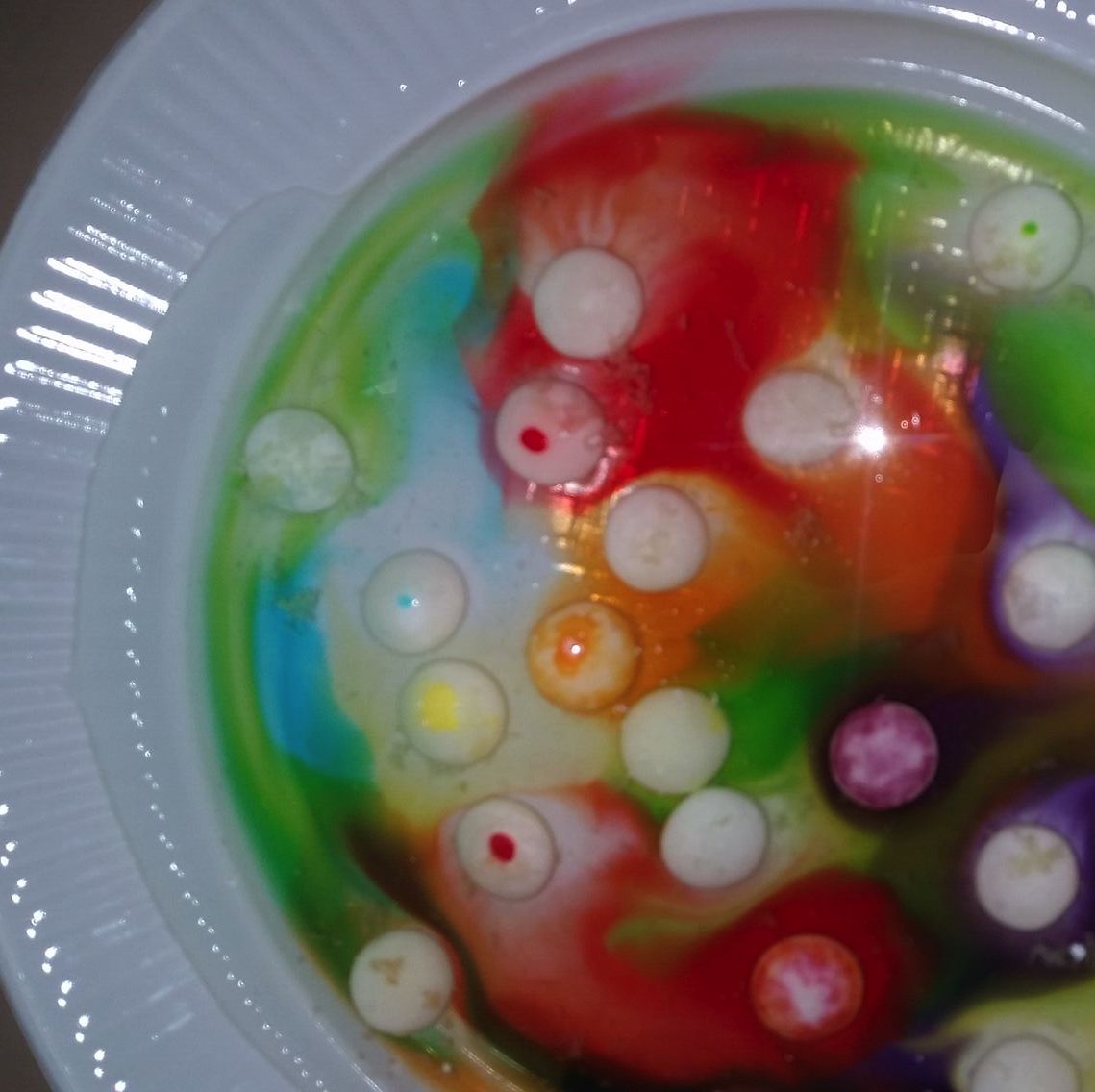
What followed was a series of fun filled lunch time sessions where we investigated why belly flops hurt (water tension), how we can get marshmallows to grow (air pressure) and how we can make raisins dance (densities of matter). Unfortunately, we have not managed to clone any dinosaurs as yet, but the request has been duly noted.

All activities are designed to ignite passion amongst pupils for Science in general, whilst at the same time challenge gender stereotypes associated with all science-related jobs. The Science Club runs on Fridays at lunch time. There is no charge associated with the club and all (except pre-school pupils) are welcome to attend. There are 2 sessions of 30 minutes each. Each session takes 10 pupils who attend on a rolling basis. There is no budget for this Science Club (see point 1 of my pitch above) so I’m always looking for free stuff (from CDs to bottle tops). It is great to see the support from the whole school with parents bringing in half of their recycling box to the office with donations for the Science Club. This demonstrates how funds are not really an excuse to stop you from having a Science Club in any given school. It also has the added bonus that sessions are skewed towards experiments which can be done at home with every day materials.

The Science Club has already grown and, in addition to the Friday sessions, I organised a one-off whole day session with Yr1 on ‘Why do green leaves go brown?’. With a view to introducing pupils to jobs in a Science related subject, the whole of KS2 went on a trip to the Somerset Earth Science Centre. Every Yr3 to Yr6 class had the opportunity to spend a whole day at the Centre learning about rocks, their uses and how to classify them. They also got to visit the Moonhill Quarry and make their own volcanoes erupt. The School also arranged to be part of Bath Taps into Science during Science week which was great to see.

Sometimes, I’m not sure who has more fun, the kids, myself or Ms Jones, who has been absolutely amazing in her support, and instrumental with ensuring that attendance is high. Her support and real passion for Science is very valuable to me and I really enjoy running new ideas by her. Her expertise on how to teach kids is very important for the success of this club. The kids’ attitude towards science is definitely changing and I can honestly say that there is nothing more rewarding than sharing knowledge with young minds and watching them develop a positive attitude towards the world around them. After Science Week the majority of Yr4 wanted to be marine microbiologists. Before that, I’m not sure how many of them knew that was even a career!

If you are thinking about setting up a Science Club, my advice to you is, just do it! There is plenty of material on the web which you can use, plus organisations like The School Gate SET and STEMnet offer plenty of support. I know it is daunting to come up with your own plan for the duration of the session and that is why I have set up a webpage where I will be documenting my ‘lesson plans’, together with details of the experiments and the necessary risk assessments. You can also find me on twitter @PipaVance so please get in touch if you would like to discuss science clubs in more detail.

About the Author:
Filipa Vance is originally from Portugal. She studied Microbiology at the University of Glasgow from where she also graduated with a PhD in Cancer Studies. She worked as a Postdoctoral Researcher at Imperial College before embarking on a career in Grant Management and development with the Wellcome Trust. She now works at the Bath Institute for Mathematical Innovation and lives in Wiltshire with her husband and her 2 kids.

Friday, 29 January 2016

Meet the Mentor: Diane Aston


Guest post by Diane Aston
Training and Education Executive; The Institute of Materials, Minerals and Mining
School Gate SET Mentor

Hello, I’m Diane. I am mum to two (sometimes wonderful) boys, Edward, age 8, and William, age 5 (“and a half, Mummy!”); wife to Tim; full-time employee; and Science Evangelist! I was asked to write this blog to try and inspire you to support science in your kids’ schools (no pressure then!) and I think the best way to do that is to tell you a bit more about me and how I got to become Dr Di!
My background is in materials engineering, though I never actually practiced as an engineer. I realised towards the end of my PhD that my real passion was in communicating just how fascinating materials are to anyone that will listen, but in particular to school kids and their teachers. I consider myself very lucky to have found a job that allows me to do this and get paid! I joined the Institute of Materials, Minerals and Mining in 2001 and now lead all of our education activities, working with children and young people from age 5 to 19, their teachers, and trainee teachers. I spend a large amount of my time out and about in schools all over the UK and still find standing in front of a group of kids and enthusing them about my passion (i.e. materials) a real thrill.
I digress, but hopefully this little detour in to my working life will help you understand bit more about what makes me tick and why I now do what I do in my children’s school. Ed was born in 2007 and Will in 2010 and it is a wonder they didn’t come out reciting my presentation to schools, or singing Monty Python’s Galaxy Song! From the start, Tim and I were keen to give them as many opportunities as possible to experience hands-on stuff about the world that we live in. Sometimes this involves taking them out to climb rocks and find bugs, other times it involves me ‘dragging’ them to Manchester Airport to see the Emirates 1400hrs departure to Dubai (an Airbus A380 if you are interested)!
So, when Ed started school I decided that it was my duty as his Mum, and someone working in STEM education, to offer my services. On his first day, after abandoning him in Foundation, I shakily walked round to the school office, explained what I do for a living and asked how I could help. The Head practically hugged me! Unfortunately she was only temporary so I had to go through it all again when the new permanent Head started a few months later.

That was in September of 2012. I became a Governor in May 2013 and it took me a while to find my feet and realise how and where I could best help. For the last couple of years I have been the Governor for science, maths and higher attaining pupils. I go in to school on a fairly regular basis to observe lessons, look at learning walls and support the maths and science co-ordinators in any way I can. Last year I made sure that the whole school (except Year 5 who were out on a trip) went in to the playground to look at the eclipse safely. I borrowed the moon rock box from STFC and spent a day in school so that all the pupils could see real moon rock and handle genuine meteorites. (I had actually borrowed it to help Ed and his fellow Beavers get their space badge, but that’s another story...). I also helped the maths co-ordinator run two sessions for parents on understanding the school’s calculation policy. I used to pop in on occasion to suggest exciting activities to bring the science curriculum to life and this is where a little acorn of an idea started to grow in to what is now a sapling oak tree.
I was in school for a Governors meeting and was knobbled by the Year 3/4 teachers who wanted some ideas on how they could explain electricity to their children in a more engaging way and how this could be related to their other topic of Chinese New Year! I blurted out a rather garbled reply as ideas popped in to my head and out of my mouth and then they gave me a look:  

“Could you come in to school and work with a small group of the higher attaining Year 4s to do some of this stuff? Please?”
I was slightly reluctant, but I’m always up for a challenge! I knew most of the children, as they were older siblings of kids in Ed’s class or I had met them from the other side of the tuck shop at school discos (I also Chair our schools parents and friends fundraising committee and before you ask, yes, I do sleep, but not enough!), so it couldn’t be that bad, could it? My first crucial decision was to decide what the children should call me. Diane was a bit too informal and perhaps confusing, Mrs Aston is my mother-in-law and Dr Aston just sounded a bit too formal so I settled on Dr Di! I felt this was a bit more fun and it gave me an excuse to talk about what engineers do and why I’m not a medical doctor. During the day I spent with my little group of twelve we learnt about atoms and electrons, how electricity flows and why some materials are conductors and other insulators. We did lots of experiments using everyday equipment so the children could explore for themselves and by lunchtime all of them knew the key components of a circuit and how to draw a circuit diagram. (Also by lunchtime they were all begging me to come and teach all their science lessons and if I couldn’t do that, could I pleeeeeeeeaaaaaaaasse come and run a science club “just for us, not for the people that mess about”.) By the end of the day the children had all coloured in the head of a Chinese dragon and created circuits using simple switches, conducting thread and paint, and green and red LEDs so that it had flashing eyes, fiery breath or glowing snot! We had a great day and it did get me to thinking much more seriously about setting up and running a STEM club.
The discussion with the Head and Science Co-ordinator went something along the lines of:
Dr Di “Can we set up a STEM club?”
Them “Yes!”
We decided it would be by invitation, only, to higher attaining pupils (and few others with a genuine love for science) so that we could keep the groups relatively small and manageable. We launched our STEM club about a year ago and, to test the water, we ran taster projects (an hour a week for five weeks). All of the children had a fantastic time designing and building super strong, stiff and light bridges from art straws (Yrs 5&6); carrying out the RSC’s global experiment on hydrogels (Yrs 3&4); and building crash helmets for eggs (Yrs 1&2). It was so successful that we have carried on this year and to be honest I think we would have been mobbed otherwise! Our first group of Year 5 & 6 attended in the Autumn Term and have just been awarded their Crest Mega Star Awards. We are now working on some more Mega Star awards with a group of Year 3 & 4 and then in the summer term we will have Year 1 & 2 children, hopefully working on Crest Star Awards.
This interest in science has rubbed off on to other kids at school as well. All of the children know me as Dr Di and I am their one stop shop if they want to know anything relating to any part of science! One little boy has declared that I am his science hero after I regaled him with science facts on every topic he could think of on the way to the Panto before Christmas.
Yes, this does sound like a lot of work and, yes, it is quite a commitment, but thanks to a supportive employer, and a very supportive husband this is all possible. But I guess the big question is:

Why bother?” 

That’s easy! Science has now become something that the kids see as normal; it is something that they can all access at some level and something that they are more willing to engage with. I see this as a great achievement and it is so rewarding for me to see their little faces light up at the thought of doing an experiment or hearing a little voice shout “Dr Di!” excitedly in the supermarket, play park or changing rooms at the swimming baths.
Primary school teachers are rarely science specialists so as an interested parent with a science or engineering background you are like gold dust! Don’t be afraid to go and have a quiet word with the Head or your child’s teacher. Lots of parents and grandparents go in to school to listen to kids read – why not offer to go in and be an extra pair of hands in a maths lesson? “Mum’s helping with maths” is a great way to show girls that it’s not just for the boys! We get a curriculum plan every half term showing us what the kids are going to be working on in each subject. If yours do the same, and they are doing something that you have experience of, volunteer to go in and help. You might go in for an afternoon and find it’s not for you but you might find you love it! If you perhaps don’t want to go into the classroom then put yourself forward as a Governor. Schools are becoming much more savvy about who they choose as governors as there are particular skills they are looking for – as a scientist or engineer you have most of these!
If you have a bit of science knowledge and a bit of time I am sure that your school would appreciate your help, you never know you might find your true vocation!

Photos courtesy of Pixabay used under Creative Commons CC0